.png)

Matasanta Mezcal (Full Line). PHOTO: Matasanta Mezcal
Matasanta Mezcal: A Ritual of Roots, Spirit, and Sustainability
The origin story of Matasanta Mezcal doesn’t start in a boardroom or with a business plan. It begins on a dirt road, under the Oaxacan sun, with a solo traveler and a feeling—one of curiosity, reverence, and something just short of destiny.
By MEZCULTURE / FEBRUARY, 2025


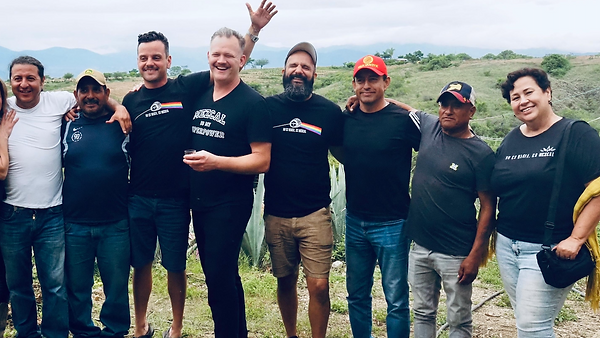
Team Matasanta. PHOTO: Matasanta Mezcal
The first trip to Oaxaca came in 2005. It was a soulful, solo journey—one of those long, slow walks through culture that leaves its mark in unexpected ways. Years later, in the thick of the global pandemic, another journey would reconnect that traveler to the spirit of the region. This time, it was a road trip from Miami to Puerto Escondido, and the road, as it often does, offered more than just a destination.
In Puerto Escondido, a meeting with Beto—now Matasanta’s co-founder—would change everything. Their visions aligned seamlessly: build something honest, something rooted. A mezcal brand that didn’t just sell a product but told a story—about the land, the people, and the sacred ritual that is mezcal.
And just like that, Matasanta Mezcal was born.
EVENTS


Matasanta Mezcal Clay Pots. PHOTO: Matasanta Mezcal
A mission born from tradition
For Matasanta, mezcal isn’t just a drink. It’s a living culture, an ecosystem, a spiritual experience in a bottle.
“We’re here to honor the traditional methods of production,” says one of the co-founders, “but also to spotlight the incredible diversity of agave and the people who shape this spirit.”
That mission takes the form of respect—for the past, the present, and the future. It’s about preserving the ancestral techniques of mezcal-making that are too often lost in a marketplace driven by mass production. It’s about telling the truth of the agave—its long maturation, its wildness, its relationship to the soil and sky. And it’s about ensuring the people behind the process—Oaxacan families, farmers, mezcaleros—aren’t just visible, but centered.
In every way, Matasanta is a tribute. To the culture. To the craft. To Oaxaca.

Matasanta Mezcal Clay Pots. PHOTO: Matasanta Mezcal
A mission born from tradition
For Matasanta, mezcal isn’t just a drink. It’s a living culture, an ecosystem, a spiritual experience in a bottle.
“We’re here to honor the traditional methods of production,” says one of the co-founders, “but also to spotlight the incredible diversity of agave and the people who shape this spirit.”
That mission takes the form of respect—for the past, the present, and the future. It’s about preserving the ancestral techniques of mezcal-making that are too often lost in a marketplace driven by mass production. It’s about telling the truth of the agave—its long maturation, its wildness, its relationship to the soil and sky. And it’s about ensuring the people behind the process—Oaxacan families, farmers, mezcaleros—aren’t just visible, but centered.
In every way, Matasanta is a tribute. To the culture. To the craft. To Oaxaca.

Matasanta Ancestral Line. PHOTO: Matasana Mezcal
What sets matasanta apart: ancestral, not industrial
In a landscape increasingly filled with polished bottles and corporate marketing, Matasanta stands in quiet rebellion.
While many brands rely on Espadín—the most widely available agave—Matasanta has taken a different path. Their nursery features over 20 rare and wild varietals, with Espadin Artesenal, Cuishe Artesenal, Tobala Artesenal, Tepeztate Artesenal, Espadin Ancestral, Castilla Ancestral, Coyote Ancestral, Arroqueno Ancestral, Jabali Ancestral and Sierra Negra Ancestral already available in the US.
These aren’t just checkboxes on a flavor wheel. Each varietal brings a unique terroir and story, shaped by years (sometimes decades) in the earth before it ever meets fire.
But it’s not just about what they use. It’s how they make it.
Matasanta is committed to Ancestral production methods. That means no mechanized tahona wheels. No industrial mills. No dilution. Just pure, hand-milled agave crushed with a wooden mallet, fermented in open-air cypress tanks, and distilled in clay pots.
It’s slow, laborious, and deeply human. But the reward? A mezcal that whispers the earth’s secrets with every sip.
Even the labels tell a story—handmade by artisans in Etla, Oaxaca, using traditional paper-making techniques. From field to bottle, every part of the process reflects a belief: that mezcal should be sacred.

Rooted in sustainability, planted for the future
The growing demand for mezcal is a double-edged sword. While it’s uplifting the category globally, it’s also putting pressure on wild agave populations and traditional practices.
Matasanta chose early on to be part of the solution, not the problem.
In 2019, they began cultivating their own agave nursery in Miahuatlán, one of the most biodiverse agave regions in all of Oaxaca. Since then, they’ve planted over 20,000 agaves—none of them Espadín—all grown from seed to preserve genetic diversity.
It’s a bold, long-term investment in sustainability. But it’s the only way, they believe, that the spirit can truly survive.
“We’re not just making mezcal,” they say. “We’re planting 20 years into the future.”
This nursery doesn’t just protect rare agaves—it provides economic opportunities for local communities, trains future stewards of the land, and sets an example for what responsible mezcal production can look like.
For Matasanta, sustainability isn’t a trend. It’s a promise.
The soul of matasanta: built by community
At its heart, Matasanta is a community project. Everyone on the team in Mexico is from Oaxaca, and they bring more than expertise—they bring heart, heritage, and deep understanding of the land they walk.
“The community in Oaxaca isn’t just one thing—it’s many,” says a team member. “Different regions, climates, languages, stories. We want that spectrum of tradition to show up in every bottle.”
And in just a short time since their official U.S. launch in 2023, Matasanta is already making waves—one tasting at a time.
Milestones so far include:
-
Two-time participant in Florida’s Mezcal Culture Fest, where they not only poured at the Grand Tasting but spoke on the Sustainability Panel, amplifying their environmental mission.
-
Their first full tasting in New York, hosted at Pueblo Viejo in Carmel, introducing East Coast drinkers to their full wild agave line.
-
A spot on the menu at a Thomas Keller restaurant in Coral Gables—an incredible nod from one of America’s most revered chefs.
-
And most recently, an account at Swizzle Rum Bar, one of the 50 Best Bars in South Beach, Miami.
For a new brand, these are major steps. But Matasanta is less concerned with speed, and more with depth.
“We’re enjoying the process,” they say. “Every conversation, every tasting, every connection. This is how we grow—organically, with intention.”

Matasanta Mezcal Founders PHOTO: Matasanta Mezcal
How to drink matasanta: the ritual of the sip
So, how do you experience Matasanta the right way?
Slowly.
This is not a spirit meant to be rushed. No cocktails just yet. No lime, no salt. Let it breathe. Let it speak.
Pour it neat, in a wide copita. Let it sit. Inhale gently—smoke, earth, sweetness, stone. Then take a small sip, or as they say in Oaxaca, a mezcal kiss. Let the flavors open on your tongue—clay from the still, roasted agave, mineral from the highlands, smoke from the firepit.
But it’s more than just tasting notes. It’s about intention. Matasanta is meant to be part of a ritual—a pause, a presence, a moment.
Set the mood. Good music. Good people. Maybe a warm night, maybe a story worth telling. This is mezcal meant for connection, not consumption.

Matasanta Mezcal Founders and friends. PHOTO: Matasanta Mezcal
What's next: a brand with roots and wings
What’s in store for Matasanta? More agaves, more stories, and more spaces to share the spirit—literally and figuratively.
They’re expanding thoughtfully—account by account, city by city. But they’re not chasing numbers or shelf space. They’re chasing meaning. Depth. Connection.
In a world of fast everything, Matasanta is a return to the slow and sacred.
Because mezcal was never meant to be mass-produced. It was meant to be made by hand, shared with purpose, and remembered long after the last sip.
So next time you raise a glass, raise one that tells a story.
One of land. Of love. Of legacy. Raise a glass of Matasanta.
Salud.